
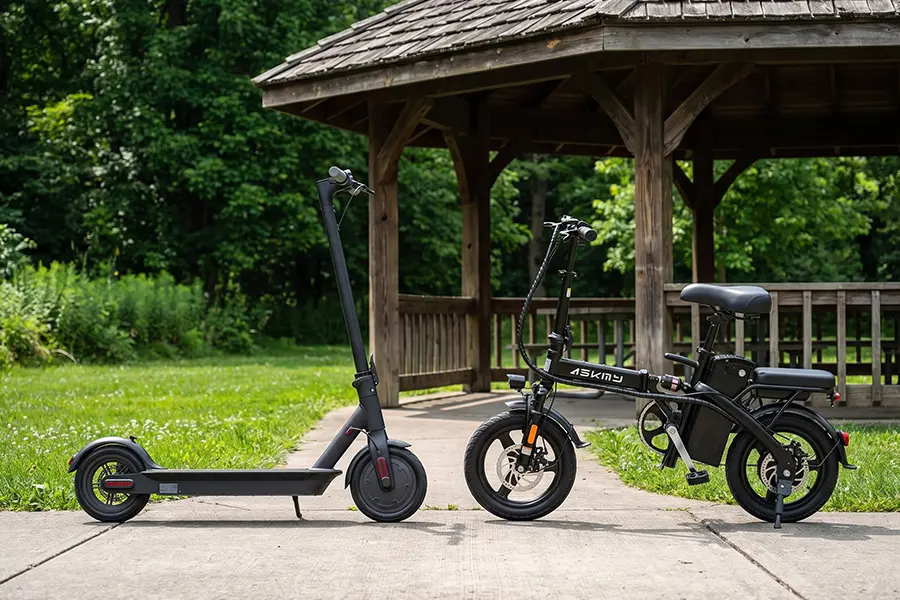
When urban commuters decide to ditch their cars or public transit, the choice almost always narrows down to two contenders: an electric scooter or a foldable electric bike. If you live in an apartment where space is at a premium and every square inch counts, making the right choice is critical.
For years, the e-scooter was the default choice for apartment dwellers solely because of its compact size. However, with the evolution of ultra-compact foldable e-bikes, the landscape has completely shifted in 2026.
Here is the ultimate showdown between e-scooters and foldable e-bikes, analyzing storage, comfort, safety, and cost.
1. The Apartment Storage Test
The primary reason people lean towards e-scooters is storage. A scooter can be folded at the stem and tucked into a closet or slid under a bed.
But what if an e-bike could do the same thing?
Modern foldable e-bikes have shattered the myth that bikes require a garage. The REOCRO RE0-14, for example, features a brilliantly engineered double-folding mechanism. Both the frame and the handlebar stem collapse inward, shrinking the bike to a mere 27.6 x 17.7 x 26.8 inches.
This means the RE0-14 fits easily into a car trunk, under an office desk, or tucked neatly inside an apartment entryway. While an e-scooter might still win by a fraction of an inch in width, the foldable e-bike has completely neutralized the storage advantage that scooters once held.
2. Commute Comfort and Ride Quality
This is where the foldable e-bike utterly destroys the e-scooter.
Riding an e-scooter requires you to stand rigid for the duration of your commute. Your knees act as the only shock absorbers, and small 8-inch solid scooter tires transfer every crack, bump, and pothole directly into your spine. After a 30-minute ride, fatigue sets in quickly.
A foldable e-bike, conversely, provides a traditional seated riding position. The REOCRO RE0-14 is equipped with:
- Dual Shock Absorbers: A front suspension fork and a center frame shock absorber eliminate road vibrations.
- 14-Inch Pneumatic Tires: Air-filled tires roll over potholes and uneven pavement that would easily launch a scooter rider over the handlebars.
- A Padded Seat: You get to sit down, relax, and let the motor do the work.
If your commute is longer than 10 minutes, the ergonomic comfort of a seated, dual-suspension e-bike is non-negotiable.
3. The Safety Factor (Fire Risk & Certification)
Bringing a large lithium-ion battery into your apartment introduces a significant safety consideration. In recent years, uncertified e-scooters and e-bikes have been responsible for catastrophic apartment fires.
When choosing between a scooter and an e-bike, UL Certification is the only metric that matters.
Many budget e-scooters cut costs by using unverified battery cells and cheap battery management systems (BMS). The REOCRO RE0-14, despite its budget-friendly price, is fully UL 2271 (Battery) and UL 2849 (Electrical System) certified by SGS. This means the battery, motor, and controller have been subjected to brutal thermal, electrical, and mechanical stress tests to ensure they will not catch fire while charging in your apartment.
Whether you choose a scooter or a bike, never buy one that lacks UL 2849 certification.
4. Range and Practicality
An e-scooter is a purely electric vehicle. If the battery dies, you are left pushing a heavy, awkward piece of metal down the sidewalk.
A foldable e-bike is, fundamentally, still a bicycle. The REOCRO RE0-14 offers up to 30-60 miles of range on a single charge. But more importantly, if you ever run out of battery, you can simply pedal it like a normal bike.
Furthermore, e-bikes offer practical utility. You can easily attach a basket or a rear rack to a foldable e-bike to carry groceries—a feat that is dangerously unstable on an e-scooter.
5. Price Comparison
Historically, e-scooters were cheaper. A decent entry-level scooter would cost around $250-$300, while e-bikes started at $700.
In 2026, the price gap has vanished. The REOCRO RE0-14 retails for just $198. At this price point, it is actually cheaper than most reliable e-scooters, yet it offers dual suspension, a 700W peak motor, a comfortable seat, and rigorous UL safety certifications.
The Verdict
If you need a micro-mobility device strictly for a 3-minute ride from the train station to your office, an e-scooter is a fine choice.
However, if you want a primary commuting vehicle that is comfortable for long rides, capable of carrying groceries, safe to charge in your apartment, and just as easy to store in a closet, the foldable e-bike is the undisputed winner. At $198, the REOCRO RE0-14 makes the decision easier than ever.
FAQ
Can I bring a foldable e-bike on the subway?
Yes! Most major public transit systems allow foldable e-bikes on subways and trains, provided they are folded before boarding. The REOCRO RE0-14 folds down in under 10 seconds, making it the perfect companion for multi-modal commuting.
Are e-bikes safer than e-scooters in traffic?
Generally, yes. E-bikes have larger tires (14" on the RE0-14 vs. 8" on most scooters), which handle road imperfections much better. The seated position also provides a lower center of gravity and better stability during emergency braking.
Is it safe to charge the REOCRO RE0-14 in an apartment?
Yes. The REOCRO RE0-14 is SGS tested to meet UL 2271 and UL 2849 standards. This rigorous certification ensures the battery management system protects against overcharging, overheating, and short circuits, making it safe for indoor charging.
How heavy is a foldable e-bike compared to an e-scooter?
An average commuter e-scooter weighs between 35-45 lbs. The REOCRO RE0-14 weighs 55.1 lbs. While the e-bike is slightly heavier, its folded shape is balanced and easy to lift into a car trunk or carry up a short flight of stairs.
Related Reading
Related Articles
Affordable E-Biking
Ready to Ride?
Experience the freedom of electric biking without breaking the bank. REOCRO foldable e-bikes offer UL-certified safety, reliable performance, and unbeatable value.
Shop REOCRO on Amazon30-day money-back guarantee. Free returns.