
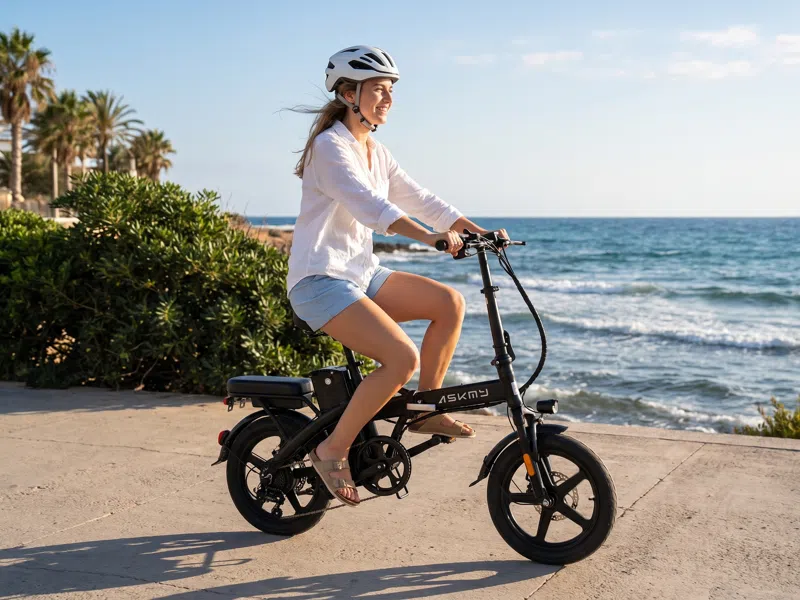
When I first decided to ditch my car and commute by electric bike, I spent hours researching on platforms like Reddit. Amidst all the exciting talk about range and speed, I kept seeing terrifying footage of e-bike battery fires. Living in an apartment building in a major city, the idea of an uncertified lithium-ion battery causing a catastrophic fire in my living room genuinely terrified me.
In response to this crisis, I noticed a massive push for UL Certification sweeping through the e-bike industry. But as a beginner, I was incredibly confused. What exactly did it mean? If an e-bike is "UL Certified," is it truly fireproof? And why were some certified bikes costing me $3,000 while others, like the REOCRO RE0-14 I eventually bought, cost just $198?
To ease my own anxiety, I went down a massive research rabbit hole. In this guide, I will break down exactly what I learned about UL 2849 and UL 2271, why I vowed to never buy an uncertified e-bike, and how the industry is finally making safety affordable for people like me.
The Science of Lithium-Ion Battery Fires (What Scared Me)
Before understanding the certifications, I had to understand the actual threat. E-bikes run on large lithium-ion battery packs. These packs contain dozens of individual cells (similar to oversized AA batteries) wired together to produce massive amounts of power.
I learned that when a battery is poorly manufactured, damaged, or overcharged, it can experience a phenomenon called Thermal Runaway.
Thermal runaway occurs when a single cell overheats, causing a chemical reaction that generates even more heat. This heat instantly spreads to the adjacent cell, triggering a chain reaction. Within seconds, the entire battery pack erupts in an uncontrollable, explosive fire that cannot be easily extinguished by a traditional fire extinguisher.
I discovered the three primary causes of thermal runaway in e-bikes are:
- Overcharging: A cheap charger failing to shut off when the battery is full.
- Short Circuits: Poor internal wiring causing electrical arcs.
- Physical Damage: Piercing or crushing the battery casing during a crash.
To prevent these disasters, independent safety organizations, most notably Underwriters Laboratories (UL), developed stringent testing standards. This is where my buying criteria completely changed.
What I Learned About UL 2271 Certification
UL 2271 is a safety standard specifically for Light EV Batteries. It focuses entirely on the battery pack itself, isolated from the rest of the bicycle.
When I see that a battery pack has achieved UL 2271 certification (often tested and verified by globally recognized laboratories like SGS), it tells me the battery has survived brutal, torturous testing, including:
- Overcharge Testing: Forcing excess voltage into the battery to ensure the internal Battery Management System (BMS) automatically cuts the power before heat builds up.
- Drop and Crush Testing: Dropping the battery onto concrete from specific heights to ensure the casing does not crack and the internal cells do not short circuit upon impact.
- Thermal Cycling: Exposing the battery to extreme freezing and scorching temperatures to ensure the chemical stability remains intact.
If a battery passes UL 2271, I can be highly confident that the battery alone is built to exceptional safety standards. But as I kept reading, I realized that wasn't enough.
Why I Insist on UL 2849 Certification
While a safe battery is critical, it is only one piece of the puzzle. The battery must interact with the charger, the motor, and the controller. This is where UL 2849 comes into play.
UL 2849 is the overarching standard for the Electrical System of e-bikes. It does not just test the battery; it tests how the entire ecosystem works together.
To achieve UL 2849, the testing laboratory evaluates:
- The Charger: Ensuring it communicates correctly with the battery and cannot deliver a dangerous surge of power while I'm sleeping.
- The Motor and Controller: Ensuring that under heavy load (like when I'm climbing a steep hill), the motor does not draw too much current and melt the wiring harness.
- System Integration: Ensuring that a failure in one component does not cascade and cause a fire in another.
My Golden Rule for E-Bike Buying: A UL 2271 certified battery is good, but a fully UL 2849 certified electrical system is the ultimate gold standard for safety.
Why Are Uncertified E-Bikes Still Sold?
I quickly learned that achieving UL certification is incredibly expensive for manufacturers. It requires paying independent laboratories (like UL or SGS) tens of thousands of dollars for testing, and it requires using higher-quality, more expensive internal components (like advanced BMS chips and fire-retardant plastics).
Many "fly-by-night" e-bike brands on Amazon or direct-from-factory websites skip this process to keep their prices artificially low. When people buy an uncertified $300 e-bike, they are playing Russian Roulette with their safety. They are relying on a cheap, untested BMS to prevent a thermal runaway event in their living room. I refused to take that risk.
How I Found the REOCRO RE0-14 (And Broke the Price Barrier)
Historically, consumers like me were forced to make a difficult choice: spend $1,500+ for a UL-certified e-bike from a major brand, or risk our lives to save money on a cheap, uncertified model.
But my research led me to a bike that shattered this false dichotomy in 2026: the REOCRO RE0-14.
Priced at an unbelievable $198, I was initially extremely skeptical. However, upon verifying their claims, I found the REOCRO RE0-14 features both UL 2271 (for its 48V 10Ah removable battery) and UL 2849 (for its entire 700W peak electrical system). These certifications were rigorously verified by SGS, one of the world's leading testing, inspection, and certification companies.
How is this possible at $198?
REOCRO achieved this price point not by cutting corners on safety, but by optimizing the physical design. The RE0-14 is a minimalist, ultra-compact folding e-bike. By eliminating heavy, oversized fat tires, massive heavy frames, and unnecessary LCD touchscreens, REOCRO allocated their manufacturing budget where it matters most: the UL-certified battery and motor systems.
The result is a lightweight (55.1 lbs), highly capable commuter bike that provides me absolute peace of mind without bankrupting my checking account.
Conclusion
The e-bike fire crisis is real, but it is entirely preventable. For me, the solution was demanding rigorous safety certification before handing over my money.
Whether you are a college student storing a bike in a dorm, an apartment dweller like me charging in a hallway, or an RV owner parking inside a garage, you simply cannot afford the risk of an uncertified lithium battery.
Always look for the UL 2271 and UL 2849 marks. Thanks to models like the REOCRO RE0-14, I no longer have to pay a massive premium to keep myself, my family, and my home safe.
FAQ
Is SGS certification the same as UL certification?
From my research, UL (Underwriters Laboratories) is the organization that writes the safety standards (like the UL 2849 rulebook). SGS is an independent, globally recognized testing laboratory (an OSHA-recognized Nationally Recognized Testing Laboratory, or NRTL) that tests products to ensure they meet the UL standards. Since my e-bike was tested by SGS to meet UL 2849, it is just as safe and legally valid as if UL tested it themselves.
Can my UL certified e-bike still catch fire?
While nothing in life is 100% risk-free, UL certification reduces the risk of battery fires to a statistical anomaly. A certified battery will only catch fire if it is subjected to catastrophic, extreme physical abuse (like being crushed by a heavy vehicle) that defeats the structural integrity of the casing. Under normal charging and riding conditions, the risk is virtually zero.
Do I really need UL 2849 if my battery is already UL 2271?
Yes, ideally. UL 2271 ensures the battery won't explode if dropped. But if you use a cheap, faulty charger that forces too much voltage into that battery over time, it could still fail. UL 2849 ensures the charger, the motor, and the battery are all designed to work together safely, which is why I insisted on a bike with both.
How do I check if an e-bike is actually certified?
I never just trust a manufacturer's website. I look for a physical UL or SGS holographic sticker or label on the battery casing and the bike frame. Additionally, you can ask the manufacturer to provide their official certification certificate number, which can be verified in the testing laboratory's public database.
Related Reading
Related Articles
Affordable E-Biking
Ready to Ride?
Experience the freedom of electric biking without breaking the bank. REOCRO foldable e-bikes offer UL-certified safety, reliable performance, and unbeatable value.
Shop REOCRO on Amazon30-day money-back guarantee. Free returns.