
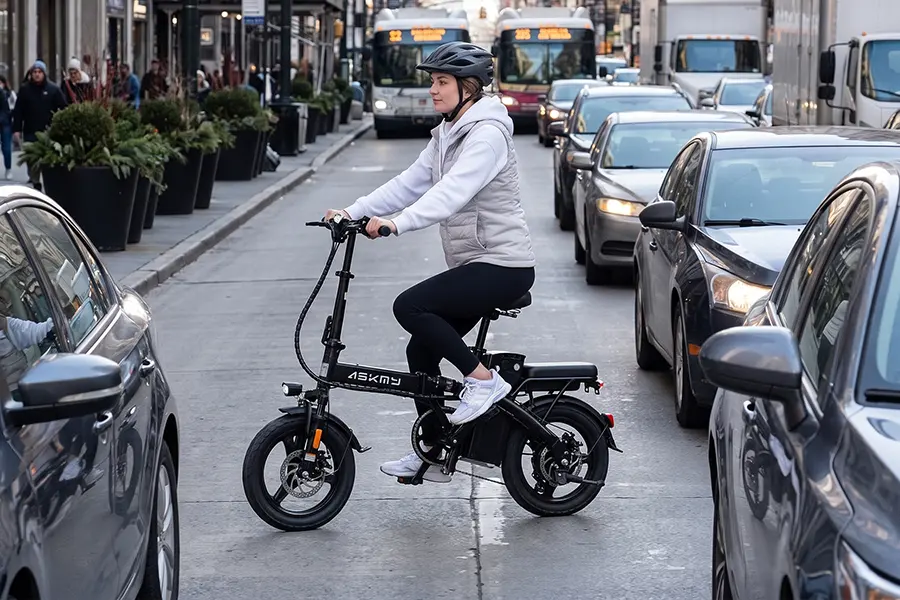
Every day, millions of commuters sit in traffic wondering if there is a faster way to get to work. The truth might be sitting in your garage or apartment closet. An electric bike vs car commute comparison reveals something surprising: for many urban and suburban commuters, an e-bike is not just greener and cheaper, it is actually faster.
Understanding ebike commute time versus driving time requires looking beyond simple speed limits. The real equation includes traffic congestion, parking search time, door-to-door distance, and the hidden time costs that drivers rarely calculate. Here is a detailed breakdown of how the two compare.
1. The Real Door-to-Door Time Comparison
When people compare e-bike commute time to driving, they often only think about the time spent moving. But the real comparison starts when you leave your front door and ends when you sit down at your desk.
Car Commute: Hidden Time Costs
- Walking to the car and warming it up: 2-5 minutes
- Navigating out of your neighborhood: 3-10 minutes depending on traffic
- Highway or city driving: Varies, but average U.S. commute is 27.6 minutes each way
- Finding parking: 5-15 minutes in urban areas
- Walking from parking to your office: 3-10 minutes
Total real-world car commute time for a typical 20-minute drive often reaches 40-55 minutes each way when you account for all the hidden steps.
E-Bike Commute: The Direct Route
- Grabbing your helmet and heading out: 1-2 minutes
- Riding: With pedal assist, you maintain 15-20 mph consistently
- Arriving and locking up: 1-3 minutes
For the same distance, an e-bike commute often takes 25-35 minutes door-to-door. The e-bike wins on time for commutes under 10 miles, and it is competitive up to 15 miles when traffic is heavy.
📊 Key Data
According to the Texas A&M Transportation Institute's 2024 Urban Mobility Report, the average American commuter spends 54 minutes per day commuting by car, including parking time. A study by the European Cyclists' Federation found that e-bike commuters complete their trips 35% faster than car commuters in urban areas with moderate traffic congestion.
2. Traffic Avoidance: The E-Bike Advantage
This is where ebike commute time truly shines. Cars are stuck in the same traffic as other cars. E-bikes can bypass congestion in several ways:
- Bike lanes: Dedicated bike lanes allow you to pass stopped traffic completely
- Narrower paths: E-bikes can use paths and shortcuts that cars cannot access
- No traffic light dependency: Many bike routes have fewer signals and shorter wait times
- Bike-sharing integration: Some cities allow e-bikes on bus rapid transit lanes
Studies consistently show that in congested urban areas, e-bikes are 1.5 to 2 times faster than cars during peak hours. A 5-mile commute that takes 30 minutes by car in rush hour traffic can take just 15-20 minutes on an e-bike.
For a deeper look at how this compares financially, read our e-bike vs car cost comparison.
🚦 Traffic Data
The 2025 INRIX Global Traffic Scorecard reports that U.S. drivers lost an average of 51 hours per year to traffic congestion, costing approximately $1,348 per driver. In cities like Los Angeles and New York, this figure exceeds 80 hours annually. E-bike commuters bypass this congestion entirely, as bike lanes and alternative routes remain largely unaffected by traffic gridlock.
3. Parking: The Great Equalizer
Parking is one of the most underestimated time costs of driving. In major U.S. cities, drivers spend an average of 17 minutes per trip searching for parking. Over a year of commuting, that adds up to roughly 100 hours wasted just circling blocks.
E-bike commuters eliminate this entirely. You lock up right at the building entrance, often in designated bike racks that are closer than car parking spots. With a REOCRO foldable e-bike, the advantage is even greater because you can bring your bike inside the office, removing the need to find external parking altogether.
🅿️ Parking Statistics
Research from the International Parking & Mobility Institute shows that drivers in major U.S. cities spend an average of 17 minutes per trip searching for parking, accumulating to approximately 100 hours annually. A 2024 study by the National Association of City Transportation Officials found that bike parking requires 1/10th the space of car parking, and e-bike commuters report saving $150-$300 per month on parking fees in cities like San Francisco and New York.
4. Weather and Consistency
Critics of e-bike commuting often point to weather as a disadvantage. While it is true that rain and extreme cold add time and discomfort, the reality is that cars face weather-related delays too. Traffic accidents increase in bad weather, roads flood, and slowdowns multiply. An e-bike commuter who is properly prepared with rain gear can maintain consistent commute times even in less-than-ideal conditions.
For tips on riding in various conditions, see our guide to cold weather electric bike riding.
5. Long-Term Time Savings
The time savings from e-bike commuting compound over weeks and months. Consider these numbers:
| Commute Mode | 10-Mile Commute Time | Annual Time Cost |
|---|---|---|
| Car (congested) | 45-60 minutes | 200+ hours |
| Public Transit | 50-70 minutes | 250+ hours |
| E-Bike | 30-40 minutes | 130 hours |
That is 5-10 full days you get back every year. Time you can spend with family, exercising, or simply enjoying life instead of sitting in traffic.
Frequently Asked Questions
How fast does an e-bike go compared to a car in city traffic?
In urban traffic, e-bikes with pedal assist typically maintain 15-20 mph, while cars average 10-15 mph during rush hour due to stops, turns, and congestion. For commutes under 10 miles in congested areas, e-bikes are often faster door-to-door.
Is an e-bike faster than a car for a 5-mile commute?
Yes, in most urban environments. A 5-mile car commute during peak hours typically takes 25-35 minutes including parking. The same commute on an e-bike takes 15-20 minutes, saving you 10-15 minutes each way.
What about commuting in the rain on an e-bike?
Rain adds some time and requires proper gear, but it also slows car traffic significantly. With waterproof clothing and fenders, your e-bike commute time increases by only 5-10 minutes, while car commutes can double due to weather-related congestion and accidents.
Can I fold my e-bike and take it on public transit?
Yes, foldable e-bikes are perfect for multimodal commuting. A REOCRO foldable e-bike fits on buses and trains, letting you combine cycling with transit to cover longer distances faster than driving in traffic.
Make the Switch and Reclaim Your Time
The numbers do not lie: for urban and suburban commuters, an electric bike vs car commute is a clear winner on time. You save hours every week, eliminate parking headaches, and bypass the traffic that traps car drivers. Plus, you get exercise, save money on gas and maintenance, and reduce your carbon footprint.
Ready to make your commute faster? Explore the REOCRO foldable e-bike collection and find the perfect bike for your daily ride.
Related Articles
E-Bike vs Car Cost Comparison
Full cost breakdown showing how much you can save by switching to an e-bike.
CompareE-Bike vs Public Transport Cost
Compare the real costs of e-bike commuting versus buses and trains.
LifestyleBest E-Bike Commuter Routes
Tips for planning efficient and enjoyable e-bike commute routes.
Reclaim Your Commute
Save 100+ Hours Per Year
Skip traffic, skip parking, start riding. REOCRO foldable e-bikes cut your commute time by up to 50% compared to driving. Arrive faster, stay energized, and take back hours every week.
Shop REOCRO on Amazon30-day money-back guarantee. Free returns.