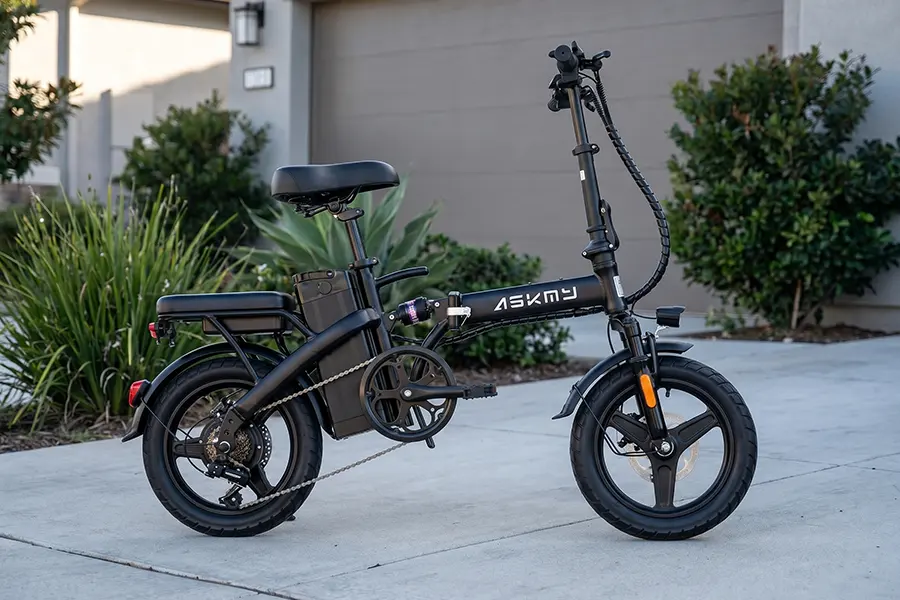
I spent three weeks researching foldable e-bikes before pulling the trigger on my first one. I read every spec sheet, watched every review, and probably annoyed the hell out of my bike-enthusiast friends with my late-night texts asking, "Is 700W peak actually good?" Spoiler: it depends on what you need.
Foldable e-bikes are having a moment right now, and for good reason. Gas prices are up, parking in major cities costs more than some people's rent, and the idea of hopping on a bike that folds into your trunk? That's freedom. But the market is flooded with options, and most of them are either wildly overpriced or dangerously underbuilt.
So here's what I wish someone told me before I started shopping: you need to focus on five things — motor power, battery range, weight, safety certifications, and price. Everything else is marketing noise. Let me walk you through each one.
Motor Power: What 700W Peak Actually Means
Every e-bike listing screams about wattage like it's the only number that matters. You'll see "750W!" or "1000W!" in big bold letters. But here's what nobody tells you: peak wattage and sustained wattage are two very different things.
Peak wattage is the maximum burst your motor can output — like flooring it on the highway for a few seconds. Sustained wattage is what the motor can actually maintain over a long ride. Most riders never hit peak wattage unless they're climbing a steep hill or accelerating from a dead stop.
For a foldable e-bike, a 700W peak motor is the sweet spot for urban commuting. It gives you enough punch to handle hills and headwinds without draining your battery in 20 minutes. Anything under 500W and you'll feel sluggish on inclines. Anything over 1000W on a foldable frame? That's overkill, and it adds unnecessary weight.
Key Takeaway
Look for a foldable e-bike with 600-750W peak motor power. That's enough for daily commutes and weekend rides without sacrificing battery life or portability.
Battery & Range: 48V vs 36V and What "Real-World Range" Really Means
Here's where a lot of first-time buyers get tripped up. Manufacturers love advertising "up to 40 miles of range!" But that number usually assumes a 150-pound rider on flat terrain, in eco mode, with a tailwind. Basically, conditions that never exist in real life.
The voltage of your battery matters more than most people realize. A 48V battery delivers more consistent power and better range than a 36V battery, especially under load. When you're climbing a hill or carrying groceries, that extra voltage makes a noticeable difference.
For foldable e-bikes, here's the honest breakdown:
- 36V batteries are fine for flat-city cruising and shorter commutes under 10 miles
- 48V batteries handle hills better, charge faster, and deliver more consistent power across the full range
- Expect 50-70% of the advertised range in real-world riding conditions
My honest advice: always assume you'll get about 60% of the advertised range. If that still covers your daily commute, you're golden. If you need every mile, go for the 48V option and keep it in eco mode.
Key Takeaway
A 48V battery gives you better real-world performance. Budget for 60% of the advertised range, and you'll never be stranded.
Weight: Stop Chasing Light, Start Chasing Smart
Here's a question every first-time e-bike buyer asks: "How heavy is it?" It's the spec that shows up in every review, every comparison chart, every Reddit thread. But most people are asking the wrong question. The real question isn't "how light?" — it's "how much bike am I getting for that weight?"
The REOCRO RE0-14 weighs 55.1 lbs. Let's put that number in context. A standard acoustic bike weighs 20-30 lbs. A full-size e-bike with a fat battery? 60-80 lbs. A foldable e-bike with a 48V battery and a 700W motor that actually delivers? You're looking at 50-60 lbs. That's the physics of packing real power into a frame that folds.
At 55.1 lbs, the RE0-14 sits right in the sweet spot. It's not so light that you're wondering what they cut to hit that number. And it's not so heavy that folding it becomes a workout. It's the weight of a weekender bag — something you can lift into a car trunk, wheel through a doorway, or roll onto an elevator without thinking twice.
Here's what people get wrong about foldable e-bike weight: portability isn't about how much it weighs — it's about how small it folds. A 55.1 lb bike that collapses to the size of a small suitcase is more portable than a 35 lb bike that stays full-size. The folding mechanism is the whole point. And at 55.1 lbs, you're getting a 48V battery and a 700W motor — the components that actually make the bike worth riding.
If you see a foldable e-bike under 35 lbs, ask what they left out. Did they shrink the battery to 36V? Drop the motor to 350W? Use a frame that flexes on every bump? 55.1 lbs means nothing was compromised. You get the power, the range, and the ride quality — folded down to fit your life.
Key Takeaway
55.1 lbs is the honest weight of a no-compromise foldable e-bike. Portability comes from the fold, not from shedding pounds — and that fold saves you 60% of the riding size.
Safety Certifications: UL 2271 & UL 2849 Explained
If there's one section you should actually read carefully, it's this one. Battery fires from uncertified e-bikes have made headlines for years, and cities like New York are now cracking down hard. Some apartment buildings and workplaces won't even allow uncertified e-bikes inside anymore.
So what do the UL certifications actually mean?
UL 2271 — Battery Safety
This certification tests the battery itself. It covers thermal stability, overcharge protection, short-circuit protection, and crush resistance. Think of it as: "Will this battery catch fire if something goes wrong?" UL 2271 ensures the answer is no.
UL 2849 — Whole E-Bike Electrical System
This one goes deeper. It tests the entire electrical system — motor, controller, wiring, charger, and battery — as a complete package. It ensures every electrical component works together safely. If a bike only has UL 2271, that's the battery. UL 2849 covers everything.
Bottom line: if a foldable e-bike doesn't have both UL 2271 and UL 2849, keep looking. This isn't the place to save money. Battery safety isn't a feature — it's a requirement. And with new regulations rolling out across the US, having both certifications means your bike is legal everywhere.
Key Takeaway
Demand both UL 2271 and UL 2849 certifications. This protects your battery and your entire electrical system. No exceptions.
Price: What $199 Gets You vs. the Competition
Let's talk about the elephant in the room. Most foldable e-bikes with decent specs cost between $500 and $1,500. That's the "normal" price range that the market has accepted. So when you see one for $199, your first instinct is probably skepticism. Fair enough.
But here's the thing about the e-bike industry: the markup on most e-bikes is insane. When you buy a $900 foldable e-bike, you're paying for a middleman, a distributor, retail shelf space, and a marketing budget. You're not paying for a bike that's 4.5 times better than a $199 one.
The reason a foldable e-bike can be $199 and still be UL certified is because the manufacturer sells direct. No middlemen. No retail markup. No marketing budget padding the price. You're paying for the bike, not the distribution chain.
What matters at any price point is this: does it have the motor power you need, the battery range for your commute, a weight you can live with, and the safety certifications that keep you safe? If the answer is yes, the price tag is just a number.
Quick Comparison: REOCRO vs. Typical $500+ Bikes
I put together this comparison so you can see exactly what you're getting. These are specs from popular foldable e-bikes in the $500-$1,200 range compared to what REOCRO offers at $199.
| Spec | REOCRO RE0-14 | Typical $500+ Bike |
|---|---|---|
| Price | $199 | $500 - $1,200 |
| Peak Motor | 700W | 500W - 750W |
| Battery | 48V | 36V - 48V |
| Weight | 55.1 lbs | 45 - 65 lbs |
| UL 2271 | Yes | Sometimes |
| UL 2849 | Yes | Rarely |
| Folding Design | Compact | Varies |
The numbers speak for themselves. You don't have to pay more for better specs. You just have to stop paying for someone else's marketing.
The Final Verdict
Choosing your first foldable e-bike doesn't have to feel like a research project. Here's the cheat sheet I wish I had when I started:
Buy If
- • You want a 700W peak motor with 48V battery for under $200
- • Safety certifications are non-negotiable (UL 2271 + UL 2849)
- • You need a bike that folds for storage and trunk transport
- • You commute 15-30 miles daily and want reliable range
- • You want Amazon's return policy and free shipping
Skip If
- • You need sub-35 lbs for carrying up multiple flights of stairs daily
- • You want a premium brand name with local dealer support
- • You need off-road capability or fat tires for rough terrain
- • You commute 50+ miles daily and need extended range
- • You prefer test-riding before purchasing
Ready to Ride?
The REOCRO RE0-14 Checks Every Box
700W peak motor. 48V battery. 55.1 lbs no-compromise build. UL 2271 + UL 2849 certified. $199 on Amazon. Free shipping.
Check Price on Amazon30-day money-back guarantee. Free returns.
Related Articles
E-Bike vs. Car: The Real Cost Comparison
We break down the actual cost of owning an e-bike versus a car for daily commuting.
MaintenanceHow to Extend Your E-Bike Battery Life
Simple tips to get more miles out of every charge and extend your battery's lifespan.
LegalE-Bike Safety Laws You Need to Know in 2026
Updated regulations for e-bikes across the US, including UL certification requirements.